New functional materials
We are actively developing new functional materials. For this purpose, we are pursuing research and development aimed at the creation of new products and businesses by combining the core technologies that we have so far developed. An important role is also played by the corporate functions of the technical development departments in each business division and by research and development that take place outside the scope of our core business. Based on the constantly shifting market forces and needs, our research and development targets the fields of functional resins, joining technology, emulsification technology, pine chemicals, and analysis & evaluation technology.
Phase change materials
In recent years, attention has been focused on energy-efficient appliances, such as ice storage air conditioners that run on cheaper off-peak electricity. At Harima Chemicals, we are developing materials focusing on normal paraffin that has large latent heat and can absorb large amounts of energy at constant temperature.

Fluorescent dyes
We recently developed a range of new fluorescent dyes. These are revolutionary new materials with a wide Stokes shift that overcome almost all of the drawbacks of conventional Fluorescent dyes. We have already developed orange, yellow and green pigments, and we are currently working on pigments with other fluorescent wavelengths.

Polylactide emulsions
Polylactides are a type of material derived from biomass sources, and they are attracting attention for use as a carbon-neutral resin that is highly effective at cutting CO2 emissions. However, polylactides are insoluble in water and tend to be hard and brittle, which has imposed limits on the ways in which these materials can be handled. Nevertheless, we have managed to solve the problems of these materials by forming polylactide dispersion using our own emulsification technology.

Granular talc
Talc is generally blended into thermoplastic resins in order to improve their mechanical properties. Talc powder itself is a material with low bulk density. It is therefore liable to form dust that degrades the working environment and reduces the efficiency with which it can be mixed in kneading machines. We have developed a granular form of talc powder that uses rosin modified resin as a binder to form talc granules from particles of talc powder with an average particle size of 1.8 µm.

Aluminum brazing materials
Aluminum brazing materials are used in the production of heat exchangers for automotive air conditioners that are more compact and have higher performance. We have developed a new concept in brazing materials by concentrating on the technology of pre-coating methods to implement low-cost aluminum brazing with higher quality.

Functional resins for electronic materials
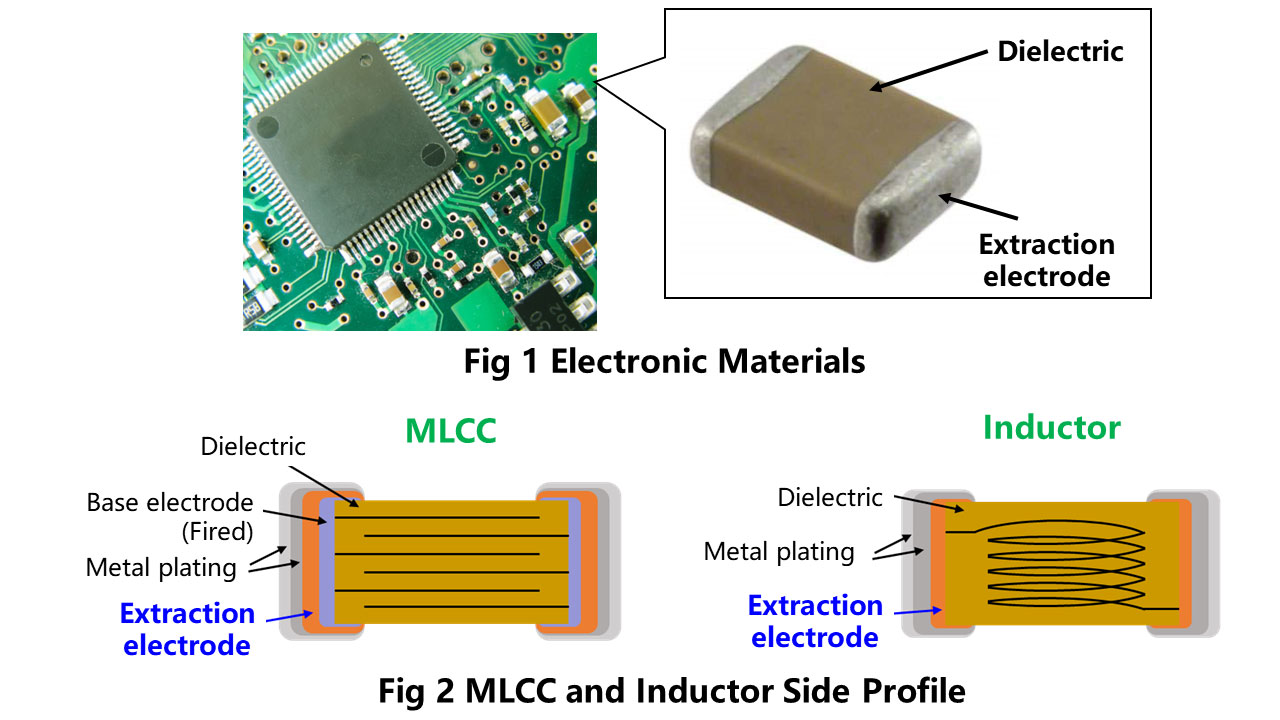
In the manufacturing process of circuit formation of electronic devices, which have undergone drastic technological revolutions of recent years, various resin technologies are employed. At Harima Chemicals, Inc. we have made further progress in traditional polymer synthesis technologies, and we have researched and developed synthesis methods for resins with new functions such as photosensitivity, photo amplification, water repellency and heat resistance.

Dispersants for ultra-fine particles
To obtain high performance dispersion, we have developed acrylic resin dispersant that can distribute various particles.
The dispersant can be tailored to suit various target particles, a wide range of target particle sizes, with or without binder resin accordingly.

Hydrophilic surface coating agents
We have developed hydrophilic surface coating agents that combine our coating resin technology and dispersion technology to produce organic/inorganic nanocomposite coating agents. Special functions that can be expected from hydrophilic surfaces including anti-fogging properties, contamination resistance and antistatic properties. These coating agents bond well to metals, plastics and even glass.

NanoPaste
The Tsukuba Research Laboratory is situated in the heart of the Tsukuba Science City, and they are working on the development of advanced materials. The laboratory are organized into two groups: one group that develops NanoPaste, which are new materials that make smart use of nanotechnology, and another group that develops conductive pastes, which use macro-sized particles to form conductive circuits.
We are making efforts to develop revolutionary new materials and technologies by exploiting our leading-edge technology and our location in the Tsukuba Science City.
Metallic pastes for fine pattern formation: NPS series
Nanoparticles that have been protected with a dispersant are stable at room temperature and exhibit behavior very similar to liquids.

NanoPaste and on-demand inkjet printing facilitate the growth of printed electronics.

Ultra-fine patterns can be formed on various kinds of substrates that exactly replicate patterns made by CAD data.
Technical reports
(1) Nobuto Terada: Photopolymer Discussions, 165th Meeting, 2007
(2) Hitoshi Saito: International Symposium on Nanoscience and Nanotechnology 2006 (Osaka University)
Conductive pastes
Copper paste for through-holes: CP-700
Copper through-holes can be formed simply by screen printing copper paste onto a pre-drilled substrate laminated with copper foil, which is then heat-cured. Compared with conventional plated through-holes, this process uses simpler manufacturing facilities, costs less, and suffers from none of the migration problems that can occur with silver through-holes. The resulting through-holes provide stability, low resistance, and superior printing properties.

Conductive silver paste as an alternative tin plated to electrode: ST-200
When tin (Sn) plated components are bonded with ordinary silver paste, the bond strength and electrical resistance are liable to deteriorate due to a phenomenon called galvanic corrosion, which can easily occur at the Sn-Ag interface. As an alternative, our conductive silver paste (ST-200) improves the water resistance of the resin, thereby effectively preventing this galvanic corrosion and achieving reliable silver paste joins with low resistance. This paste can be supplied by screen printing, from a dispenser, or by transfer printing.

Technical report
(1) Katsuhisa Ohsako: Micro Joining Research Committee, 2006